 I'm so excited about the student's work from this project, I decided to make a collage of some of their self portraits! From top left clockwise is Emily, Lauren, Erin and Mary Rachel. We took digital pictures, converted them to grayscale and they reproduced their image into a picture plane of 4 quadrants. They treated each quadrant with separate color relationships. Mary Rachel's is digital, the others were created with multi media. Great work, girls!!

Friday, November 14, 2008
Student Work - AP 2D Studio Art
I'm so excited about the student's work from this project, I decided to make a collage of some of their self portraits! From top left clockwise is Emily, Lauren, Erin and Mary Rachel. We took digital pictures, converted them to grayscale and they reproduced their image into a picture plane of 4 quadrants. They treated each quadrant with separate color relationships. Mary Rachel's is digital, the others were created with multi media. Great work, girls!!


Monday, November 10, 2008
The Design of the Flag
 Tomorrow is Veteran's Day - a time to celebrate the important job our Military does to preserve our freedoms. Flags fly everywhere as we reflect. This site is dedicated to the United States Flag. Our flag is an artistic expression of this country - each color, shape and arrangement symbolic of this great land.
 (From the website:) 50-Star Flag: Executive Order of President Eisenhower dated August 21, 1959 - provided for the arrangement of the stars in nine rows of stars staggered horizon tally and eleven rows of stars staggered vertically. This is the current flag of the United States. Hawaii was admitted as the 50th state on August 21st, 1959. The 27th flag of the United States became the official flag on July 4th, 1960. Nine presidents have served under this flag; Dwight D. Eisenhower (1953-1961), John F. Kennedy (1961-1963), Lyndon B. Johnson (1963-1969), Richard M. Nixon (1969-1974), Gerald R. Ford (1974-1977), Jimmy Carter (1977-1981), Ronald W. Reagan (1981-1989), George Bush (1989-1993), William J. Clinton (1993-2001) and George W. Bush (2001-present)*.
So check out the beginnings of our flag and notice flags of other countries. States and even cities have flags! Why not design a personal flag for yourself?
Wednesday, November 05, 2008
Obama's Logo Design
 Watch this video narrated by Mark Scheffler from Chicago: A Crain's Chicago Business video profile about the firm that developed Barack Obama's logo.
 Logos are incredibly powerful visual symbols used in society. We see clear designs that are simple and direct represent complex groups of people throughout society. They play a very important role in Visual Culture by communicating quickly and efficiently. Obama's logo is new and exciting. Don't be surprised to see it in lots of places - even AFTER he's been elected president! What other people, places and companies can you think of that have similar "brands" or logos? Post a comment and let us know what comes to your mind!
Sunday, November 02, 2008
Political Cartoons
 Election day is close at hand. It got me thinking about the Political Cartoon and it's power. These cartoons allow the artist to communicate a complex situation in a quick and direct way. The site I have linked to this post title is a page from Dr. Paul Parker's university website. He teaches political science at Truman State University in Missouri. This webpage is a wonderful little history of the political cartoon. He outlines the 4 things an effective political cartoon need to have: 1) good artistry, 2) genuine sentiment, 3) uncomplicated imagery and 4) the subject must be of lasting nature.
 I teach Art I and Speech Communication (one semester credit of each). I mix the two disciplines up all year to make it more fun and interesting for both student and teacher. Art and Speech are both about communication! It is a wonderful interdisciplinary combination. A persuasive speech is typically on the list for the year and political cartoons are perfect for the speech's visual aid. This gives my students a chance to try their hand at political cartooning.
Wednesday, October 29, 2008
Women in Art - Video
.jpg)
Check out this video (link in the post headline) that shows 500 years of women portrayed in art. Incredible.
Op Art


Victor Vasarely (1908-1997)Vega-Nor, 1969
Check out the display in the hall at school to see more of his work.)
6 days until the election - boy, the tension is super high - fundamental shifts in reality - seemingly polar energies in the country - 'you're either fer 'em 'r against 'em - crazy, wild energy.
I was thinking about the blog, trying to go to sleep, but I was just too wound up from a heated political conversation with a relative. There were also media loops and sound bytes circling in my head. Then it came to me: op art. That was totally it - two opposing forces in perfect harmony with each other. Typically, it's the high contrast and energy vortex of the lines that overtakes the frontal cortex. Rods and cones in a frenzy. The site linked in this post headline takes you to a FABULOUS, small website about Op Art.
Tuesday, October 28, 2008
Artist of the Week - Justine Smith
 Money, money, money! That is one of the major topics in the news right now - AND, we get minute by minute updates - what's up, down, gone, promised, lost, hoarded, slashed or stashed. It got me thinking about artists that might work with money, so I googled and found Justine Smith, a British artist whose medium is primarily paper and can be more specifically money. Here's what her website has to say about this piece I'm featuring, "Money Map of the World" 2004/05.
"Her work is an exploration of our relationship with money and our response to it, in a political, moral and social sense, whilst also exploiting the physical beauty of the note. A Banknote is not only an abstract representation of our labour, but the imagery depicted on it also symbolises the ideas and ideals of a given country's culture and the society that its people live in.
The 'Money Map of the World' compounds many of Smith's ideas relating to money. This piece of work took seven months to produce and is made up of banknotes from every country in the world. The images and cultural symbols on the banknotes are significant and can give an indication not only of the economy of a given country, but also important aspects of its culture. Aside from more obvious images of the local flora and fauna, one can also see elements of a country's history, religion, its aspirations and defining achievements. In some areas such as the Middle East, spiritual and cultural alliances can be seen as groups of countries appear to merge due to the similarity of Islamic design on the banknotes. One can also see economic alliances such as the Eurozone, or West and Central African states, which share common currencies between a group of nations. Similarly, one can also see traces of old empires - some countries borders are naturally formed by rivers or mountains, but other countries borders are man-made and to an extent divided by money."
Have you ever thought about the artistic design that goes into money? The images that are promoted, the ideas, the POWER symbols. When do we stop "seeing" money - what does it represent to you? What do you think about the cutting up of money to create an art piece? We "buy" materials to make art; is it the same when we "buy" money as an art material? Look at the areas certain bills covers - does that indicate the power of the country? What makes some countries money stronger than others? Interesting stuff...
Saturday, October 25, 2008
Student Work - AP 2D Studio Art
 There is a wonderful little book I bought years ago entitled "Inspirations for Embroidery Mail - Book of Days" by Jytte Harboesgaard and Debra Virgens. The two women began embroidering equilateral triangles and sent them to each other as a form of communication. After many years, they had 48 embroideries that were collected into an exhibit at The Danish Museum of Decorative Art in Copenhagen. A small sampling of their efforts is displayed as a triangle montage.
 I gave my AP Studio art students an assignment based on this idea...take a geometric shape and explore pattern, design and color in your own piece. I feature K.C.'s terrific solution, sans color, but with such strong design and precision of line the color is not needed. Her exploration is innovative and exciting! Bravo K.C.!!

Tuesday, October 21, 2008
Art Block
 What happens when you have an idea in your head but are having trouble getting it down on paper?
 Thanks for asking this question, Alex J! Blocks can be annoying and frustrating! My advice is really pretty simple....draw, draw, draw. Transferring an idea you have in your mind's eye to paper can sometimes be difficult. I suggest you just sketch small parts of your idea and keep after it. Try to grab on to some part of your vision. Are there some special colors (do a quick color study), are there some dominant shapes (block out the shapes to see how you can organize the composition), what art material do you want to use (PLAY with that material by exploring what kinds of lines and value you can get)...these smaller steps can get the juices going and can help get into your idea.
Monday, October 20, 2008
Art class and Assigned Projects
 Hello Ms. K's Chester Academy Grade 8 art class! Glad to see you are continuing to visit my blog! LS commented on the Art & Stress post, and I feel like I HAVE to respond directly to them, Ms. K's class and my own art students! LS's comment was about the lack of stress when he/she worked in the privacy of their own place versus working on assignments in the art classroom they might not choose for themselves and how those were stressful.
Well, this comment is just tooooo juicy and I feel I MUST respond to this issue! It is a common remark made by art students everywhere! LS - I do know how you feel! Remember, your teachers have been to some formal art training too, and we remember working on projects that we didn't pick AND possibly were resistant to! I suppose life would be so much nicer if we could just do what we wanted all of the time. BUT, I am asking ALL art students everywhere to open your minds to what I have to say about this!
One way to think of our brain is to liken it to a muscle. And just like muscles, they adjust to certain jobs that they do day in and day out without exerting any additional effort. What's really interesting about the brain is how it is organized into two hemispheres with very different jobs - sequential, rational activities (the left brain) vs. creative, intuitive activities (the right brain). This site about "Art and the brain in the learning process"says that, "By using more the left hemisphere, considered as rational, we do leave out the possibility of taking advantage of the benefits brought by the right hemisphere, such as creative imagination, serenity, global view, capacity of synthesis and ease of memorization, among others." It is very important that we stretch and challenge the right side of the brain in order to have an all over better functioning brain. Listen to what else they say: "When we lead all our life exercising almost exclusively the functions of the left hemisphere, or the right side, then degenerative brain diseases, so feared such as Alzheimer Disease, for instance, appear. We need therefore, to stimulate the diverse areas of our brain, helping the neurons to establish new connection, diversifying our fields of interest, searching to know ourselves better to act with more accuracy and precision."
Exercising is the key word here! We need to engage the brain in new and different activities in order to keep it healthy and ready for new challenges that might pop up. And that ALSO means using our left brain for those logical, sequential endeavors like math and computer science. A fully exercised brain is a strong, healthy, happy brain!
Back to the art classroom....your teacher (no matter who it is) is giving you a variety of assignments to explore different techniques, materials and ideas. Left to your own natural preferences, you might not discover something new and wonderful! See what a professional artist has to say about "Building the Creative Muscle". I especially like what he has to say about this process: "Studio tricks, attitudes and physical exercises jiggle the liquid brain into building the creative muscle." It gets down to venturing into new territories that might be out of your comfort zone (thereby creating "stress"). But you know what that old saying is - "Nothing ventured, nothing gained". Perhaps art students around the world can think of those assignments as adventures and possibilities. Only YOU know what you are going to find by exploring!
Keep up the great work art students! (P.S. - this is my drawing of the muscles of the head I "had" to do in figure drawing class. Thank goodness I got the opportunity to try this! The abilities I "didn't know" I had helped to increase my excitement about art!
Saturday, October 18, 2008
Art and Stress
 I love teaching art, but there can be a conflict in that there is no time for ME to make art! Ay carumba!! Now, if you love making art, you know that NOT making art can be super stressful. There's a need to release those creative ideas, but more importantly, during the art making process, your brain switches into a neutral zone and stress seems to vanish.
I teach in the Dallas Independent School District, and the last month has been very stressful. Our district was over budget last year and this millions and millions of dollars. The solution reached was to lay off hundreds of people in the school district - administration, teachers, counselors - the fickle finger of fate reaches into unexpected corners. We lost our new counselor this week, Mr. Villa, and though he was with us a short time, we are sorry he fell victim to the RIF.
With everything going on in the national financial scene, my own general anxiety level has been high AND I have felt like I've been living in parallel universes between national and local school district emergencies. Time to make some art. I decided to make the project that my AP Studio classes are doing - a design project using geometric shape to explore pattern and design. Oh, joy! It was fun and healing. I highly recommend it! Check out the link in the title of this post to find out more about do-it-yourself art therapy!
Wednesday, October 15, 2008
Student Work - AP 2D Studio Art

The last project of the six weeks was a still life drawing. I love setting this up. I've invested in several different masks that are worked in with other objects (the usual pillows, bottles, baskets, etc.) for exciting focal points. Navi Dhaliwal's drawing is featured because of what he wrote on his critique sheet. He was concerned that in drawing the objects, he gave them his own twist instead of portraying them totally realistically. But, he said, he liked his drawing that way and so did I. It's tricky business drawing from life. Sometimes the most faithful portrayal can be made, but it loses the spark of the individual artist. I think it is more exciting for the viewer to see the objects through the artist's lens...dynamic and personal.
Sunday, September 28, 2008
Redneck Art made with BBQ Ribs
 Ha! William sent me this great link for another food art blog entry.....BBQ sauce! The You Tube video is fun....I wasn't sure where they were going for a bit, but then it all started coming together. This would be a monochromatic painting, using tints and shades of the same hue, art students!
Saturday, September 27, 2008
Student Work - AP 2D Studio Art
 We have started a new year in Studio Art and I am starting a new feature...I will highlight student's artwork from my class so you can see what we are up to. This assignment was to create a composition using letters and numbers. Janeth chose to spin off Picasso's "The Old Guitarist" from his blue period. This period was between 1901 and 1904 and was characteristic of monochromatic color work. Janeth has created a very successful solution, using the tints and shades of blue in the letters to create the modeling of the figure. Great work! Oh, and check out this site to learn more about his blue period!
Sunday, September 21, 2008
Artist of the Week: Jean-Luc Cornec
 Jean-Luc Cornec created this exhibit for the Museum für Kommunikation Frankfurt in 2006. These images flew around the web and got to me through my affiliation with the Dallas Handweavers and Spinners Guild. That group loves sheep! In fact, many years ago I collected images of sheep...such docile and comforting animals they are. Making art out of recycled materials is great on so many levels; it's totally clever - you have to scrounge, but don't have to buy fancy, expensive art materials - it's fun making something wonderful out of cast-offs - it brings the public's awareness to "stuff" and the issues we have with disposing of our "stuff" - and it really shows the creative spirit in all of it's glory! The link in the title takes you to a post by Doug that is a fabulous treatise on this particular installation as well as the importance of recycled art. Be sure to read his post!
Saturday, September 13, 2008
Artist of the Week - Mario Mariotti
 The post title link will take you to several images of the fantastic ingenuity of the late Mario Mariotti, an artist from Florence, Italy. Knowledge is so important, but creative thinking is invaluable in all walks of life. His work is evidence that there is creative potential in things that are common, everyday and right under our noses!
Saturday, September 06, 2008
08/09 Academic Decathlon Image #1
 Metropolitan Cathedral (Art during the Colonial Era)
This cathedral in Mexico City (also known as Catedral de Mexico) was built by Claudio de Arciniega and others, 1573–1817. Hernán Cortés (the conqueror) destroyed Aztec temples that were on this land and ordered the construction of a Catholic church built on the same site. The cathederal was built to look like those in Spain. Watch this short YouTube video - be there now! You can get more detailed information from this Wikipedia page.
Monday, September 01, 2008
 I LOVE MY BLOG! I got a communication from a teacher of art classes for grades 6-7-8 at Chester Academy in Chester NH that was interested in being epals with me!
 Judy Krassowski sent me this question to respond to, "This week 8-1 Art is working on a 10-figure pattern/linear or radial collage that features their colored pencil drawings of wooden figure models that incorporate pattern to enhance shape and form (we'll be posting all classworks on Artsonia in the next few weeks). From this project, we utilize classroom students as live figure models for a watercolor experiment and then (AND THEN!) we begin our charcoal (with a bit of eye color) self portraits! What advice do your students have for creating artworks of people whom you know?"
I can't wait to see your projects! They sound really interesting. Soooooo....what advice do I have? It's so simple and so hard at the same time, and your teacher may have said this to you before, but it bears repeating. Develop the way you SEE things! Many art students draw what they THINK they see, not what they actually see! Example - when drawing a person, we usually draw what we think the head (or feet, or hands) looks like instead of looking at the actual lines that are formed by objects. Notice what kind of lines are created in objects - straight, wavy, angled, so many kinds of lines. So LOOK while you draw and don't take your eye off your subject. The more you draw what you see, the better your drawings will become. Oh, and let me know how my advice works out for you! Send me a comment when you work on your projects! Good luck!
Ms. Miller
Sunday, August 17, 2008
Artist of the Week - Banksy
 Graffiti can be a controversial subject. Before I went to Rome this summer, people told me how ugly it was because of all of the graffiti there is in the city - well, there were some sections of Rome that DID have a lot of graffiti. Certainly the largest issue is that of personal property...would YOU want someone painting stuff on something you paid for and owned? Probably not. But it can't be denied that it is an art form that lives on and is very dynamic.
Banksy is a British artist that takes graffiti to a new level...check out his website. What makes his art so interesting to me is the juxtaposition of imagery with political ideas. This image shows two young children with traditional beach toys, yet the trees seem to have been blown over by some terrible storm. The additional contrast of color with grey tones adds to the tension in his image. Fascinating guy.....oh, and he pulls some pretty funny art pranks you can see on his site....check out the video links!
Monday, May 19, 2008
Apple Logo Fosters Creativity
 I saw reference to this article on another blog - visual exposure to the Apple logo can cause more creative thought as stated in ScienceDaily (Mar. 30, 2008). In a Duke University study, students were briefly flashed with the Apple and IBM logos - subliminally. Each group was asked to list uses for a brick outside of building a wall, and the group that had exposure to the Apple logo had more creative and unusual uses listed. A great example of visual culture and how branding affects us on a subconscious level. Fascinating stuff; I have been talking to my students about the impact of visual culture in their everyday lives for some time now. I am a recent convert to the Mac, iLife and all that that entails. Just yesterday, I put my own Apple logo decal on the back window of my Beetle (how cosmic that I just saw this article!) and I have my own testimonial...I am definitely thinking more creatively since I got my MacBook!
Friday, April 25, 2008
Where have I gone?
 Months have passed.....sometimes I say that it feels like I am hurtling through the space/time continuum. Teaching, a heart surgery and a conference would be the explanation for the absence. I love my blog and hope you, the viewer find enjoyment! Let me know what you think!
Thursday, December 27, 2007
The Art of the Rubik's Cube
 There is a quiet craze in our school over the Rubik's Cube - students shuffle through the permutations looking for the "solution". Brian Chorr is the driving force behind the popularity. He recently sent me this link "Ms Miller, here's some of that stuff I was telling you about." with this link in the post title. Okay, Brian - it is blog worthy! I had no idea you could create patterns using this puzzle machine! I thought it had one desired solution (matching one color on each plane) - au contrair! Now I see the pure potentiality of artistic creation in rubik's dimensionality. Oh, and dear reader, as my students already know - multi is my favorite color! Viva Rubik!
Wednesday, December 26, 2007
Artist of the Week - Kim Nguyen
 Oh, the holidays! What a sweet time -for teachers and students a much needed break. But what also comes along are gifts - food, sweets, gift cards, all greatly appreciated. But when a student gives a gift from the heart, a tear comes to the teacher's eye! Kim is a student in my AP Art History class. One day while lecturing, I noticed she was folding paper during class. Having had busy hands during my life, I was not angry, but curious about what she was doing. She told me about a bird she was making from her folded paper, and I asked that she let me see her creation before she gave it away. This is the photo of the bird she gave away - beautiful. And, to my surprise, before leaving for our holiday break, she gave me my own bird in white with pink and yellow accents! Kim, I will treasure your gift always. Here is what she wrote about the process.
"Origami is a type of art that began in Japan many centuries ago. This creative art of paper folding requires lot of patience and time. I was 9 years old when I was inspired by this model of a bird that my dad brought home from work one day. For 2 consecutive years I've wasted a lot of time and papers in order to try and copy that model, but for some reason the body of the bird never quiet came out right. It bothered me to the point where I just decided to give up. However, one day a thought just came to my mind that reversed my decision...I simply changed up the way that I was putting the pieces together and BAM the body came out as I wanted it be, and from there I continued to build up the neck, wings, and tails. It was a confusing process at first, but the final product paid off. Since then I've been cutting and folding alot of papers during my spare time so that I can have it ready for assembling whenever it is called for. :D
The process for making this bird is quiet confusing and complicated for the beginner, but once you get the hang of it then it's not so bad. The part that I hate doing most is cutting and folding of those tiny pieces of paper. It can take me days up to weeks, depending on how many pieces I need and how much spare time I have, which is not much lately. Once ALL the pieces have been folded then I could begin to glue all the pieces together. The first part is the body, the part where I had the most trouble with. Then I built up the 2 wings. After that I would assemble the tails (there are 3 in my model). The neck and "feet" would be last because they are the easiest parts to make. This might sound easy but it's not!"
Thank you Kim! You are an artist after my own heart - creative, diligent and generous!
Saturday, December 15, 2007
Driftwood Horses
 I'm thinking about 3 dimensional art today and remembered this email I got from a friend a while back with pictures of horses made of driftwood. Really beautiful! One of the biggest problems for these works is balancing the sculpture since horse's legs are really thin compared to their body mass. I've linked the artist's website to the title for more viewing of the process as well as her work.
Monday, November 19, 2007
DMA Visit & AP Art History Extra Credit!

LOVE the Dallas Museum of Art Late Night events! In AP Art History last Thursday, we took a glance at Indian miniature paintings, I donned a sari and we had an Indian Feast! Just the thing we all needed at the end of the six weeks. Domains of Wonder: Selected Masterworks of Indian Painting is opening at the DMA Nov. 18 runs until Jan. 27. Any of my students who visited the DMA Late Night Fri., Nov. 16 or who visit the exhibit can respond to this post (make it juicy!) and you will get extra credit!
Sunday, October 28, 2007
Phil Hansen - Multi Media Artist

Thank you Sofia! I love it when my students turn me on to art out in the world!
This title links to Phil Hansen's website which shows an incredible array of work!! There are many kinds of artists working in today's world, but he is really unusual in that he works in MANY kinds of media. His art skills are so strong, he moves from one material and technique to another, playing with new ways to make art. Work on his site is made from matches, Starbucks coffee cups, chalk, text that is cut and pasted, and bibles that are cut up, resized and pasted. The self portrait shown here is made of wood, using a router and skill saw to remove material, then stained to create the image. He also gives himself a monthly challenge, or theme and creates art for the month using that idea. Check out his work - it is interesting and powerful!
Sunday, September 23, 2007
TAG Art Club goes crazy!

Fun! Fun! Fun! The TAG Art Club is making Artist Trading Cards this year! This is a hot new art craze that is spreading around the country and I can see why. The cards are the same size as sports trading cards we've collected as kids - 2 1/2 X 3 1/2" each. On the back, you can put your name, email, school, date, or whatever to "tag" it as your own work. Then, you create away! The sky is the limit - you can use any material or technique to make your card. They are tiny works of art, and though the space is small, the impact is large! Even if you think you "can't do art" - (and you know what I think about that!!!) - you can absolutely do this! Cut, paste, doodle, dribble, color, invent, PLAY, embellish, compose, express, paint, draw, stamp, sew, emboss, stick, did I say PLAY?!
07/08 Academic Decathlon Art Selection #18

Hey, if you want to be remembered, have yourself carved into a mountain! This "Memorial to the Confederacy" was carved into Stone Mountain in George by Gutzon Borglum in 1916. Now, that does not sound like an American name to me! Who was the artist and how did he come about getting this commission to carve this Memorial?
07/08 Academic Decathlon Art Selection #17

Portraiture is a wonderful genre in that it not only captures the people, but also their times. "The Westwood Children" is painted by Joshua Johnson in 1807. His style is primitive - it is obvious looking at the painting that he is self taught and working out the issues as he can. Though primitive, it still captures the children, though they seem stiff and doll like in the portrait. Perhaps during a long sitting, he can only capture a "non-emotional" expression OR perhaps they were bored out of their minds!
07/08 Academic Decathlon Art Selection #16

Soooo, continuing our discussion about European art tradition! The Seine is an oft painted river, but Henry Ossawa Tanner was not your regular artist! As an African American artist, he found more opportunities to paint (and be accepted) in Europe than back home. He was an important artist that flourished during the Harlem Renaissance (this piece was painted in 1902). The American art critics did not appreciate African American artist's painting in the style of Europeans, though. They felt they should paint in the style of their "native country" - Africa. Thank goodness the African American artists of the early 20th century had the pluck to blaze their own trail. If you study the Harlem Renaissance, you will find a plethora of artistic growth - jazz for one!
07/08 Academic Decathlon Art Selection #15

Early American art was not as valued or sophisticated as the art tradition from Europe. This did not stop aspiring artists to blaze a new trail in this new country! "The Lackawanna Valley" by George Inness in 1856 is an example of working in the respected genre of landscapes. Notice how nicely he captures the quality of light be it dawn or dusk. We may not have had a great art tradition when this country was founded, but we had vistas that compared with the greatest in the world!
07/08 Academic Decathlon Art Selection #14

This is an illustration by Alexander Davis from 1865. It documents the architectural home called Lyndhurst built for George Merritt in Tarrytown, NY. What a grand residence! Any architecture buffs out there? What kinds of architectural styles are used in this work?
07/08 Academic Decathlon Art Selection #13

George Caleb Bingham painted "Mississippi Boatman" in 1850. The Mississippi River was a major waterway (and still is!) for the country to move goods to different states. My husband tells a story about being a deck hand on a Mississippi tow boat during a summer while he attended college. It sounds like it might be an easy job, floating up and down the river, but many hazards lay in waiting. What sorts of stories does it look like this boatman has?
07/08 Academic Decathlon Art Selection #12

Ah, "out west"! It still has a romantic quality about it today. This is a photograph of Canon de Chelle by Timothy H. Sullivan done in 1873. Photography was still an early medium. As cumbersome as it was, people dragged their equipment and developing chemicals along with them to document this still unfolding nation. It was a great way for photographers to promote new American locations to people looking for adventure!
07/08 Academic Decathlon Art Selection #11

This is an Alkaline Glazed Stoneware Jar made by David Drake in 1862. Have you ever made anything out of ceramics? Do you know how they are fired in a kiln? See what you can find out about this piece. It may not be beautiful to our aesthetics today, but I guarantee that Mr. Drake felt great personal satisfaction after the successful completion of his project!
Sunday, September 02, 2007
07/08 Academic Decathlon Art Selection #10
 This is "The Seine", by Henry Ossawa Tanner, painted in 1902. A beautiful scene - Tanner handles the paint in a fresh manner. Doesn't it remind you of the Impressionists' technique? Tanner's work is beautifully emotional and expressive. Check him out and see some of his other work. What do you think?
Tuesday, August 07, 2007
07/08 Academic Decathlon Art Selection #9
 Mary Cassatt is a favorite artist. Officially a member of the Impressionists, she painted this piece "The Boating Party" in 1893. She loved painting women and children in the theme of mother and child. Now, to tell you the truth, I'm not sure WHY this piece is considered to be a piece of art for the Civil War?!? Can any of you come up with an idea? Seriously!
Wednesday, August 01, 2007
07/08 Academic Decathlon Art Selection #8
 Ahhh - the shotgun house - so named because if you opened the front & back doors and fired a gun, the bullet would shoot straight through. This is a 19th c. house, kind of raggedy, huh? Well, I spent a year living in New Orleans and working in the French Quarter when I was a young twenty something ( I sold women's shoes in a shoe boutique!). I certainly got an education working in the Quarter, but I also experienced living in an old shotgun house (not quite THIS old!) There was a big fan (like an attic fan) that was in one of the windows in the back room, and when it ran it drew the air through the house and exited out the fan. Even though we had no air conditioning (can you get your brain around that?), I remember feeling pretty comfortable even in the heat of the summer (New Orleans can be hot and extremely humid!). Search around - find out about what kind of housing was lost during Katrina - are they rebuilding this style of architecture again? Interesting...
Tuesday, July 24, 2007
07/08 Academic Decathlon Art Selection #7


Abraham Lincoln Memorial - of all the presidents, he seems to be one of the most interesting. I love looking at his face - craggy with deep set eyes, prominent cheek bones and a strong jaw. His physical presence is reflected so beautifully in Daniel Chester French's sculpture of him. A couple of summers ago I was in Massachusetts and got to visit the studio of the sculptor. This photo shows part of the artist's work space. One interesting feature of his studio was a short railroad track that ran up to the big double doors he had installed. By having his sculpture on a rail cart, he could roll it out onto the tract to see it in natural light. Sculpture is a dynamic art form - viewed from all angles as well as being greatly influenced by its light source. What else can you find out about this monument?
Sunday, July 15, 2007
07/08 Academic Decathlon Art Selection #6
 This painting is titled "A Visit From the Old Mistress" by Winslow Homer, painted in 1876. My art question for this post is to find out about Winslow Homer...he is one of the great American painters. I visited the Women's Museum in Dallas last week, wandered into the gift shop (one of my FAVORITE parts of museums!) and found several books on women's involvement during the Civil War. We tend to think of it as involving primarily the men, but aux contrair! This little gem of a book (yes, "little") is from a series entitled Women Who Dare and is about the Women of the Civil War. With brief accounts and photographs of some of the women who supported their husbands, sons and brothers during the conflict, I think you will find it really interesting! Google women + civil war and see who you find!
Saturday, July 07, 2007
07/08 Academic Decathlon Art Selection #5
 This is the Shaw Memorial by Augustus Saint-Gaudens, 1900, a patinated plaster work of art, through the U.S. Department of the Interior, National Park Service. This really goes along with the book I've been Reading "Rebel Private: Front and Rear" by William A. Fletcher. It is one of the few authentic memoirs of a Confederate Soldier. The book has been quite interesting - his language is stiff and formal and seems to be missing a lot of the English conventions such as prepositions and punctuation at appropriate places! I still have not quite gotten used to it, though there is enough language to understand the gist of what he went through. Oh my gosh - what hardships the soldiers, both Rebel and Union, went through. Plundering whatever surrounding area they found themselves in for rations, usable horses and miscellaneous supplies. Anyone else's needs were not important in their eyes, and I just have a hard time imagining people of our own land busting in and taking all of my valuables and resources for basic survival. He was wounded several times, recouperated and then hustled back to the front line of the conflict. Not a long book, though NOT an easy read, you may borrow it if you like. It's an interesting bird's eye view of the civil war.
 Back to the Shaw Monument - let me know what you can find out about it! The gold patina over the plaster is a cost efficient way to make a fancy looking monument. What do you think?
Saturday, June 30, 2007
07/08 Academic Decathlon Art Selection #4
 This lovely plantation is called Oak Alley Plantation in Louisiana. Aren't the trees really beautiful! Oaks can live to be many hundreds of years old. See what you can find out about Oak Alley which was begun in 1837. How were plantations pivotal in the Civil War?
Saturday, June 23, 2007
07/08 Academic Decathlon Art Selection #3
 This photo is called "The Sick Soldier" and is the work from the Mathew Brady Studio, 1863. Photography is a huge contributor to war journalism. Now images from the scene of the battle could be captured for people to see. How did this new technology contribute to people's views on the war? Check out Mathew Brady and find out how new this technology was at the time. How has technology changed our perception of wartime?
Friday, June 15, 2007
07/08 Academic Decathlon Art Selection #2
 Quilting has such a rich tradition in our country! This Bible Quilt was made by Harriet Powers in 1886. Can you figure out some of the bible stories that she is illustrating? Where did she come from and I wonder how this quilt was preserved. One thing about textiles, they are more sensitive to the elements (the sun can DESTROY a piece of cloth!) and are more difficult to preserve. PLUS, critters love to munch on fibers. One of the main stresses on fabric is too much love! When we use, launder and revel in textiles, they begin to deteriorate. I have a quilt of my grandmother's and I remember seeing her tucked in her bed under her quilt. I have it now, and when I wrap up in it, I rejoice in the pattern, colors and the fact that my grandma & I are sharing the experience even though she is long gone. Do you have a favorite quilt or quilt story from your family? Maybe you have another kind of textile story. I'd love to hear about it!
Friday, June 08, 2007
07/08 Academic Decathlon Art Selection #10
 Watson and the Shark
John Singleton Copely
1778, Oil on canvas
72 X 90 1/4"
Museum of Fine Arts, Boston
Woah - this is a dramatic scene captured on the canvas! What is the
story behind this painting? Not an AcDec image, but the Raft of the Medusa by Gericault has a lot of
similarities. What is the story behind THAT painting? How are they alike? How are they different? Why were these paintings made?
Wednesday, January 10, 2007
Pencil Tip Art - Jennifer Maestre

LOVE this sculpture! Such a simple material - pencils along with the use of repeating a unit over and over. This work has a real psychological presence as well as being VERY textural! I think of Venus Flytraps, porcupines, sea creatures. I am drawn to this work and creeped out by it as well. I have the link attached to the Blog Title so you can see more. Unfortunately, this site has no information about the artist! I did a quick Google search to find out who they are, but was unsuccessful. Let me know if someone out there figures out who the artist is - inquiring minds want to know! Thanks, Mr. Martin!**Update comment 10/24/08** Thanks to the high school art teacher in Lawrence, MA that found a link to Jennifer's work. I've put a hyperlink to her website in the post title - check out her work!
Sunday, January 07, 2007
Janez Jevnikar - Sprayman
 "Aerosolgraphia" (spray painting) is a fascinating technique for producing art and it not limited to surreptitious grafitti excursions. This artist uses spray paint to create complicated compositions. You can click on the the title above and visit his website. There you will see videos demonstrating his method of painting. Because of the nature of the acrylic spray paints, he has to work extremely quickly to get the effects he wants before the paint dries. In the video, he creates a scene in ten minutes AND his studio is on the street, so he is being watched the whole time by an audience. Notice how he works from back to the front in his compositions. He obviously has a great deal of experience with his materials and techniques to be able to work so quickly!
Tuesday, January 02, 2007
Contemporary Tapestries
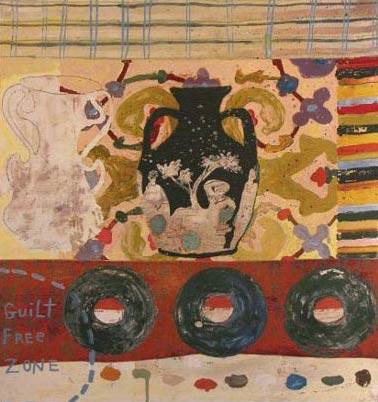 Textile Arts are one of my biggest passions! As an art form, they continue to grow conceptually but also technologically as well. The descriptions below each tapestry at the Klaudia Marr Gallery exhibit in Santa Fe indicate an edition size of each design. The tapestries can be sold this way because of the electronic jacquard weaving equipment they are produced on. This allows the artist unlimited design freedom (the designs are read by pixels) as well as a limited production run of their design. VERY COOL!
The Jacquard Loom was the first piece of equipment to use punch cards to control a sequence of operations. Although it did no computation based on them, it is considered an important step in the history of computing hardware. This exhibit shows the best of artistic expression and technology - how exciting and how beautiful!
Subscribe to:
Posts (Atom)