Follow Me on Pinterest
Showing posts with label Drawing. Show all posts

Friday, February 04, 2011

Snow Days & Artist of the Week

My own See.Saw picture - Christine Miller - date, the great blizzard of 2011

Unprecedented! We have missed 4 days of school this week because of this massive winter storm that has stretched across the country! Talk about a long winter's nap!! I haven't been napping. It has been a wonderful time for me to work on several projects: weaving samples for my guild's overshot study group, taking the scans from my Sketchbook Project's book and making a digital version, goofing around on the computer, and playing with this art idea I stumbled upon (if you haven't been on this site, you have to go! Be prepared to burn some major time stumbling!!).

It's not a new idea, but I like what the artist has done, and he inspired me to try it for myself. I think this would be a great project to take into my art classes! Lots of grade school teachers do it to make butterflies and such - you put paint on one side of your paper, fold it closed, open it and you end up with these identical paint splotches on both sides. (I was so excited, I forgot to take a picture of my splotches before I drew my picture!) I used cadmium red pale hue, cadmium yellow, and cerulean blue watercolors. I also splashed some beautiful gold watercolor out of a Japanese pot. It didn't take me long to see the monkey, bird and camel in my drawing. The golden ribbony smoke came next, then I thought to add the Aladdin's lamp and the carpet at the end. It was fun! Check out the link in the post headline to see the original site I stumbled upon. It's the work of L Filipe dos Santos from Madrid, Spain - he calls it his See.Saw series. You can see more of his work here.

Wednesday, March 25, 2009

Artist of the Week - Julian Beever


Anamorphic illusions are images that are drawn in a certain way so that when they are viewed from a special angle they appear three dimensional. This technique was used as far back as Renaissance times, but Julian Beever is well known for his sidewalk chalk drawings that utilize this method. You may have received an email that featured images of his work - I know he's cycled through my inbox more than once!

Let's look at one of his images in the "regular" view.....
Making Poverty History, Julian Beever

Here's how he has to draw it to get it look three dimensional....
Making Poverty History, Julian Beever

For my art history students, this oblique anamorphic technique is closely related to tromp l'oeil (which in French means "trick the eye") - actually, I think it is also tricking our brain!! You can only see the image as might expect to find it from one particular viewpoint. Remember Hans Holbein the Younger's work? It has an anamorphic skull in the lower section of the composition positioned between the Ambassadors. You see the distorted view as you look at the painting straight on:
The French Ambassadors, Hans Holbein the Younger, Oil on oak, 1533

Fascinating....

Tuesday, October 21, 2008

Art Block

What happens when you have an idea in your head but are having trouble getting it down on paper?

Thanks for asking this question, Alex J! Blocks can be annoying and frustrating! My advice is really pretty simple....draw, draw, draw. Transferring an idea you have in your mind's eye to paper can sometimes be difficult. I suggest you just sketch small parts of your idea and keep after it. Try to grab on to some part of your vision. Are there some special colors (do a quick color study), are there some dominant shapes (block out the shapes to see how you can organize the composition), what art material do you want to use (PLAY with that material by exploring what kinds of lines and value you can get)...these smaller steps can get the juices going and can help get into your idea.

Sunday, July 30, 2006

Drawing - Fun for All!


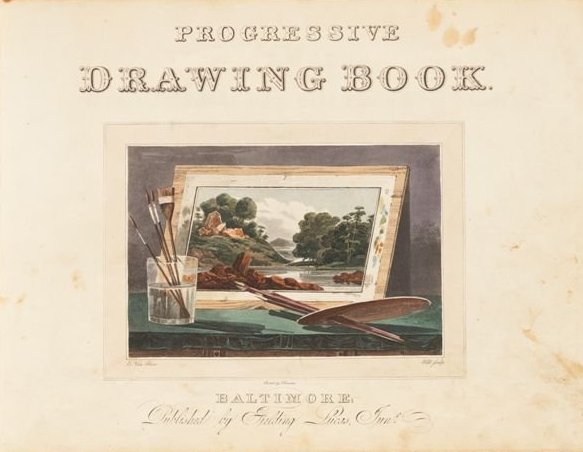
As an art teacher, I hear it all - from "I love to draw" to "I can't draw a straight line!". Drawing is a learned skill like many other endeavors, and this exhibit features drawing manuals from the 18th - 20th centuries. During this time period art instruction was not a specialty subject like it is now, but was part of a well-rounded education. When we draw, we "see" the world in a unique perspective. Through the use of our body and mind to record what we see, the barriers of inside and outside become blurred - we create a special experience for ourselves regardless of the artistic outcome. People these days take drawing too seriously when it is truly meant to be a fun, creative activity. Our ancestors appreciated it for what it was - a part of a well-rounded education!